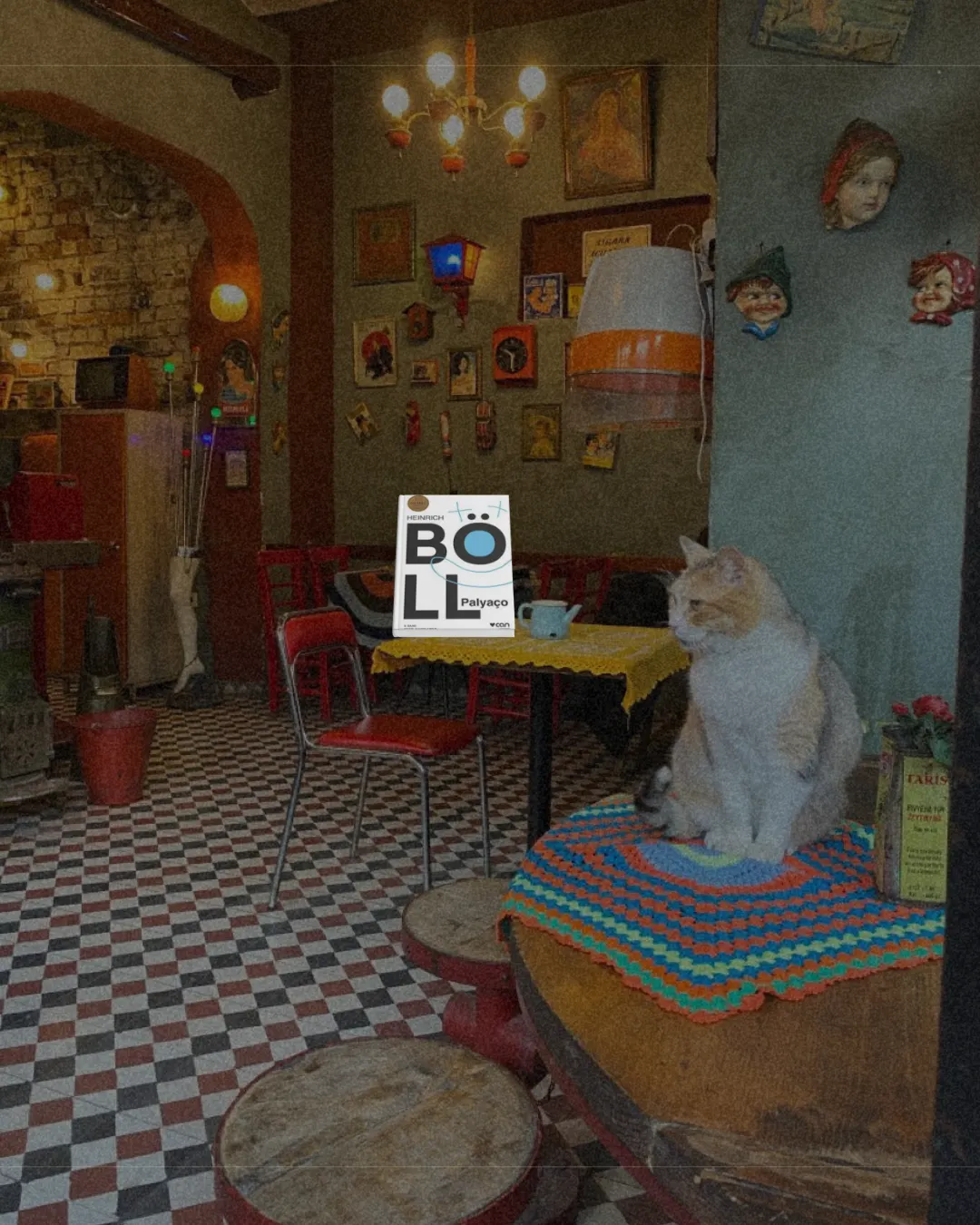
Palyaço (The Clown), Heinrich Böll
Of course they know that a clown, to be a perfect clown, has to be melancholy, but it never occurs to them that, for him, melancholy is a very serious matter.
It turns out this is Heinrich Böll’s best-known work, though sadly I have only just discovered it. It is the first book I have read by the Nobel laureate. I loved it and will be reading many more of his books. To understand Palyaço better, I also picked up Kayıp Babanın İzinde: Heinrich Böll’ün “Palyaço” Adlı Yapıtında Geçmişle Hesaplaşma (In Search of the Lost Father: Reckoning with the Past in Heinrich Böll’s “The Clown”).

Heinrich Böll’s novel Palyaço (The Clown) is a striking critique of the individual and society, portraying the moral, religious and ideological fabric of post-war German society through the eyes of a clown who has been cast out by it. The novel covers a span of just a few hours in the Bonn flat of Hans Schnier, a professional mime artist; yet this narrow window opens into a broad social and psychological panorama as the narrator keeps returning to the past through flashbacks. Through this structure, Böll weaves together the inner world of the individual and the collective memory of society.
Heinrich Böll’s novel Palyaço (The Clown) is a striking critique of the individual and society, portraying the moral, religious and ideological fabric of post-war German society through the eyes of a clown who has been cast out by it. The novel covers a span of just a few hours in the Bonn flat of Hans Schnier, a professional mime artist; yet this narrow window opens into a broad social and psychological panorama as the narrator keeps returning to the past through flashbacks. Through this structure, Böll weaves together the inner world of the individual and the collective memory of society.
Driven to alcoholism by his disappointments, Schnier can no longer practise his profession and has hit rock bottom financially. Throughout the novel he phones old friends, family and acquaintances, trying both to find out about Marie and to find financial support. But these calls only make his estrangement from society more visible. No one really wants to help him; everyone hands out moral advice, but no one takes responsibility. This lays bare the hypocritical morality that prevailed in post-war German society.
Through Schnier’s memories, Böll also sharply criticises the National Socialist era. The Nazi oppression, informing and ideological bullying that Schnier witnessed in his childhood and youth are constantly felt in the background of the novel. His family’s position during the Nazi period, and his mother’s supposedly humane but in fact self-serving attitude, reveal that the war wrought not only physical but also moral devastation. Even though the war is over, the novel stresses, the mentality and power relations it created live on in society.
One of the novel’s greatest strengths is its critique of the Catholic Church. Böll portrays the Church not as an institution of faith that protects the individual, but as a structure that intrudes on private life and turns moral norms into instruments of oppression. Schnier’s refusal to marry is branded immoral by the Church; yet Böll shows that this “morality” serves to compel obedience rather than to make people happy. Schnier’s observations at Catholic gatherings expose, with irony, the cultural shallowness and smugness of these circles.