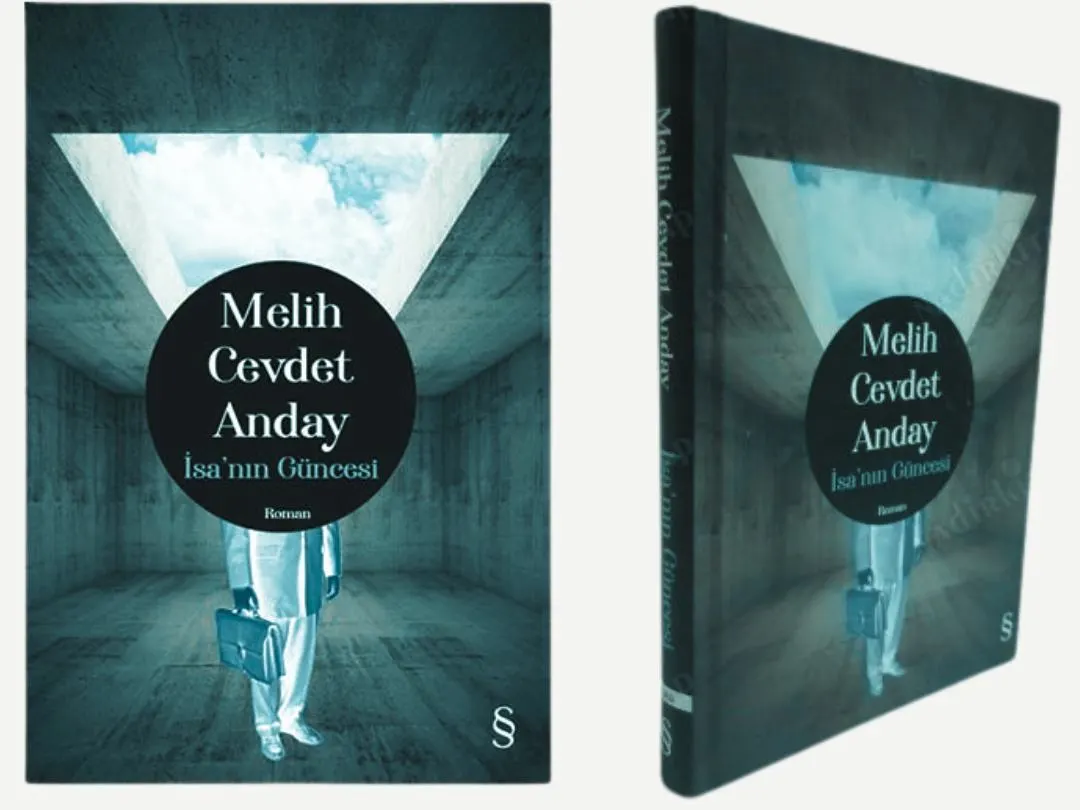
Written from within a dark tunnel of consciousness, this novel by Melih Cevdet Anday reads as a quiet elegy for the inner collapse of modern humanity.
Some books leave a strange silence inside you when you close them. You neither quite love them nor can you ignore them. They unsettle you, yet that unease feels like a jolt of awareness. The book in your hands has no interest in telling a comforting story; instead it becomes a mirror that forces you to confront your own darkness. Melih Cevdet Anday’s İsa’nın Güncesi (Isa’s Diary), written in the 1970s, is one such novel.
A Life Lived in the Shadow of Routine
In the opening pages, the protagonist’s life is thoroughly ordinary. He leaves home in the morning and goes to work. After work he calls on his lover, then the tailor. Towards the end of the day he goes to a bar, drinks beer with his brother-in-law and finally returns home to spend a few hours with his sick wife. This repetitive flow has reduced his life to an almost mechanical routine. There is neither excitement nor any great collapse; but it is precisely this stasis that deepens his quiet disappearance from within.
Then one day everything changes: he moves to a new job. He finds himself inside a bureaucratic structure called something like the “Import Warehouses and International Electronics Union”, whose actual business is never clear. There he is met by a desk, a chair and a steel safe. The four sheets of paper he finds when he opens the safe mark a turning point. From that moment on, he faces an unending series of interrogations.
Interrogations, a Lost Identity and a Kafkaesque World
From here the novel turns into an existential nightmare. The protagonist is interrogated without knowing what he stands accused of. Different people in different places bombard him with questions. His answers are never enough, because he himself does not understand what he is caught up in. It brings to mind Josef K. in Franz Kafka’s The Trial, where the individual, trapped inside an unknown system, tries to defend himself without knowing the charge. Here too the system is irrational, yet the protagonist tries to remain rational — and this gradually wears him down.
The protagonist’s name is never mentioned in the first half of the novel. As readers trying to connect with him, we realise that we are in fact facing an “absence”. An identityless, nameless, unresponsive man… until his wife addresses him as “İsa”. Yet even whether this is his real name remains uncertain. A name is an identity; in this character, identity is blurred. İsa ceases to be merely an individual and becomes the faint, repressed representative of modern humanity.
The Anatomy of Submission
İsa is a passive figure. He makes no decisions for himself and falls silent when accused. He does not defend himself even in the most intimate matters with his wife. She blames him for their childlessness; he simply thinks, “if that is how it must be, so be it.” This submissiveness appears not only in his private life but also in his stance towards the system. Throughout the book İsa objects to nothing, because for him this is simply how life is. One must always be afraid, never question, and simply go with the flow.
These lines from the opening pages of the novel seem to sum it all up:
“Just as we cannot live without germs, we cannot live without anxieties; it is best to endure them. That is why I am wary of comfort, of happiness.”
Here, even wanting happiness seems a kind of arrogance, as if happiness were a privilege fit only for kings, heroes or the rich, while the ordinary person must exist, like animals, with hunger, fear, sex and silence.
İsa’nın Güncesi: Should You Read It?
İsa’nın Güncesi is not an easy read. It may even unsettle some readers or leave them feeling stifled. But that is exactly why it is valuable. Books that challenge us, that force us to think, that at times suffocate us and even “do us no good” can sometimes open the door to a genuine reckoning.
İsa is identitylessness, silence and passivity made flesh. His story is not only that of one character but also of the silent part within us, our suppressed fears and the moments when we have forgotten how to question.
Yes, this novel offers no comfort. But it is highly recommended, because some books are read not to be loved but to be shaken.