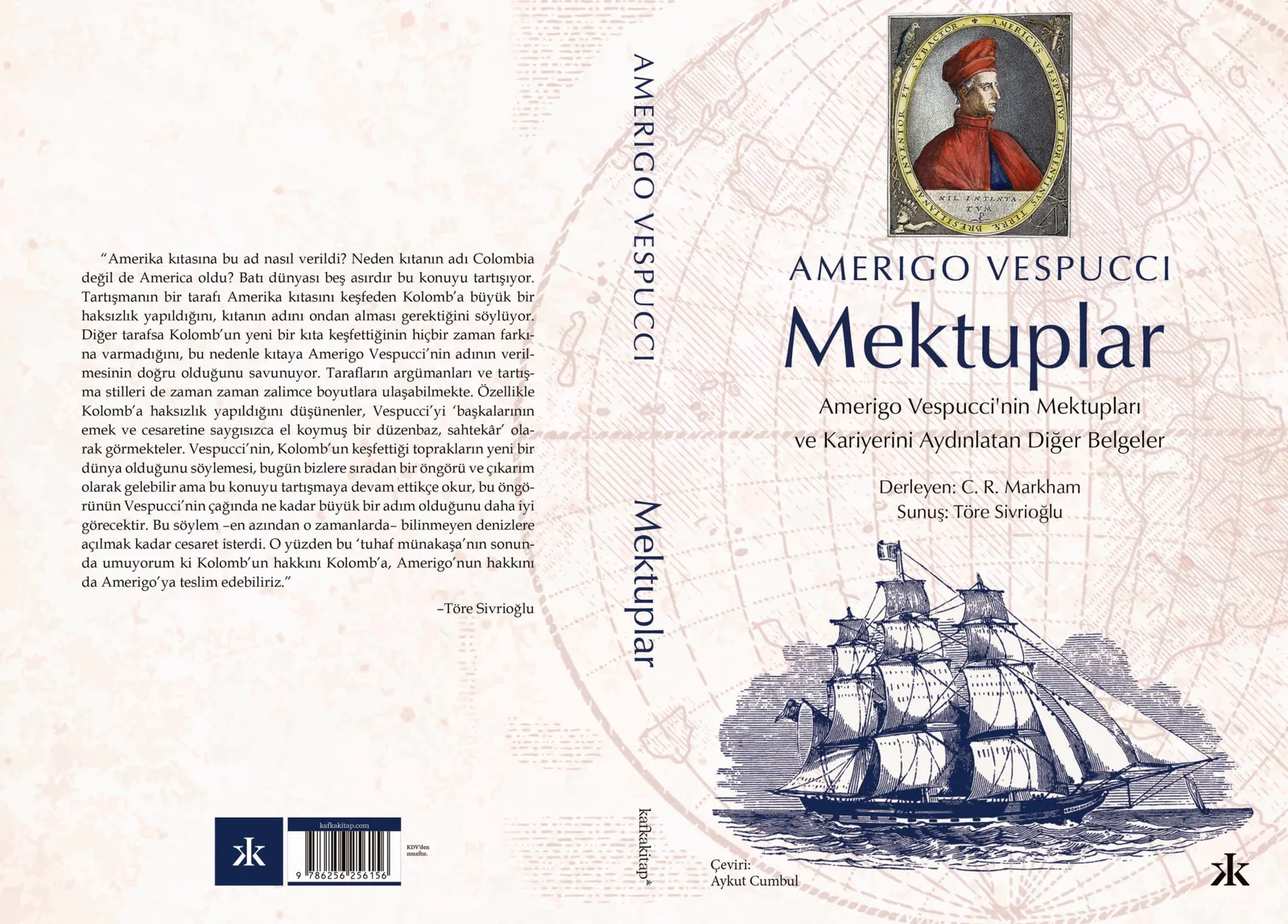
Vespucci’s letters, his testimonies and the commentaries of his contemporaries have been translated into Turkish in full for the first time. Five centuries on, the letters bring readers the story of the “New World” and the Age of Discovery from Vespucci’s own pen.
Kafka Kitap has brought into Turkish “Mektuplar” (Letters), a collection that gathers the letters of Amerigo Vespucci, one of the most controversial figures of the Age of Discovery, together with contemporary testimonies and official documents. Documents shedding light on the historical debates behind how the Americas got their name, on criticisms of Columbus and on the birth of colonialism are being published in full for the first time.
Who could have guessed that a series of letters written five centuries ago could be influential enough to decide the name of a continent? The book offers the chance to follow, step by step, how the name “America” came into being. Vespucci’s travel letters in his own hand, the reports he presented to the King of Portugal, the document granting him Spanish citizenship and the letters he wrote to Columbus’s son place the debate over who “discovered” the continent in its historical context.
This collection is not merely a journal of discovery; it is also a book of historical memory, showing how knowledge, authority and naming became intertwined.
A Silent Rivalry with Columbus
“Mektuplar” reveals, through primary sources, the silent rivalry between two great explorers, Columbus and Vespucci. Although Christopher Columbus’s voyages are more visible in the history books, Vespucci’s letters were a turning point that changed the very definition of the “New World”. Vespucci’s lines contain shores Columbus never saw, observations recorded beneath different stars and the first ethnographic descriptions of the “New World”.
Seeing himself as the “narrator of discoveries”, Vespucci conveys in his writing not only what he saw but also the mindset of his age: faith in the unknown, a scientific spirit shaped in the shadow of religious references, and a view of nature and of “new peoples” in all its contradictions.
Read alongside the testimonies of contemporaries who argued that Columbus had been wronged, “Mektuplar” reveals not a historical polemic but the spirit of an age.
Vespucci’s letters also reveal a gift for observation ahead of his time: a mind trying to shed the prejudices of the era as it described the ways of life of the native peoples, and a scientific outlook that laid the foundations of cartography. Even so, his contemporaries accused him of “sheltering in Columbus’s shadow” or “claiming too much credit for himself”. “Mektuplar” offers the chance to hear this historical debate first-hand.
The Golden Age of Cartography and the Birth of Science
Vespucci’s accounts point not only to geographical discoveries but also to the birth of science. Each voyage is like a laboratory in which cartography, observation and measurement developed.
In Vespucci’s lines we can see how Europe combined naval power with science, how missionary zeal and curiosity became intertwined, and how colonial thinking began to take root.
From Primary Sources, a Mirror of an Age
The letters are a reference work not only for historians but for every reader interested in human curiosity, adventure and the very idea of discovery. Compiled by C. R. Markham, “Mektuplar” has been translated by Aykut Cumbul, with a foreword by Ulaş Töre Sivrioğlu. In “Mektuplar”, readers have the chance to witness, through Vespucci’s eyes, both the birth of an age and the ethical and political debates behind the concept of “discovery”. These texts are a reminder that words powerful enough to name a continent can still resonate five centuries later.
From the Back Cover
“How did the American continent come by its name? Why was it called America and not Colombia? The Western world has been debating this for five centuries. One side of the debate says that Columbus, who discovered the Americas, suffered a great injustice and that the continent should have been named after him. The other side argues that Columbus never realised he had discovered a new continent, and that it was therefore right to name it after Amerigo Vespucci. At times the parties’ arguments and styles of debate can turn cruel. Those who believe Columbus was wronged in particular see Vespucci as ‘a trickster and a fraud who disrespectfully appropriated the labour and courage of others’. Vespucci’s claim that the lands Columbus discovered were a new world may strike us today as an ordinary insight and deduction, but as the debate goes on the reader will come to see what a great leap this insight was in Vespucci’s time. Such a claim – at least back then – took as much courage as setting sail on unknown seas. So I hope that at the end of this ‘strange quarrel’ we can give Columbus his due, and Amerigo his.”
Töre Sivrioğlu