Can Yayınları has announced its publishing programme for April 2024. Can Yayınları and its imprints are bringing 20 books to readers this April.
Can Yayınları
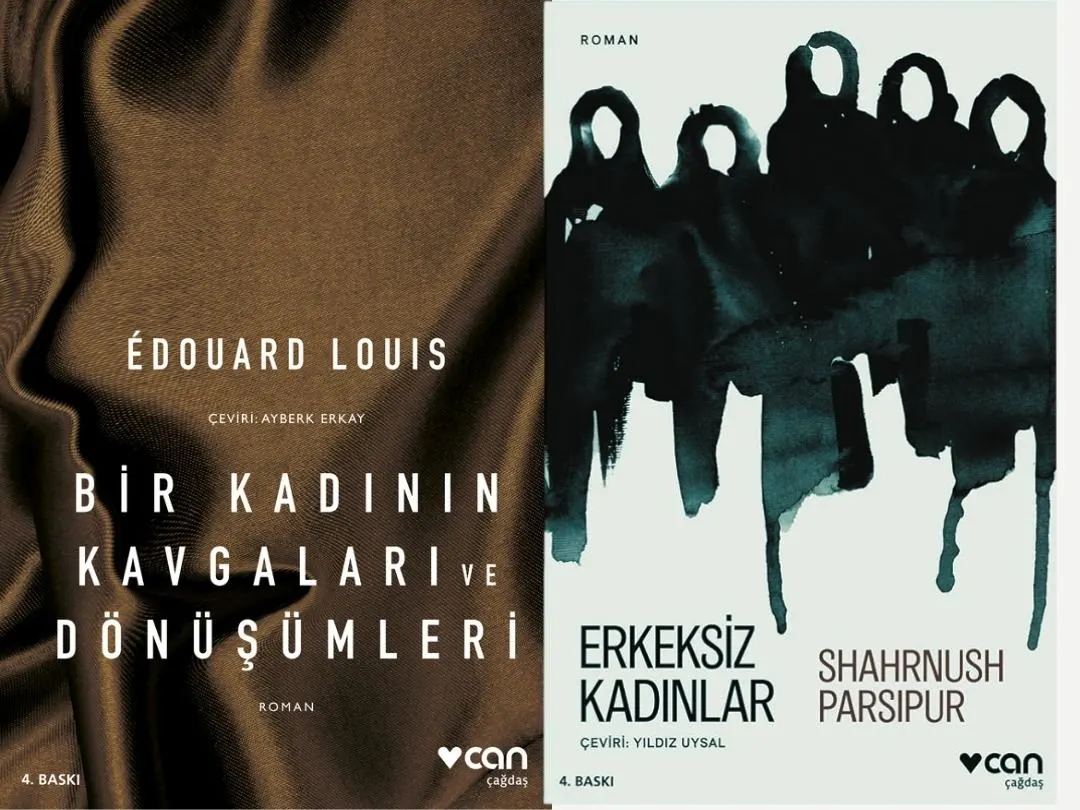
- One of today’s most influential young writers, Édouard Louis, turns his attention to his mother in Bir Kadının Kavgaları ve Dönüşümleri (The Struggles and Metamorphoses of a Woman). Recounting through memory one woman’s passage from one social class to another in French society, he makes the reader a witness to her transformation.
- Banned shortly after publication for its depiction of female freedom, Erkeksiz Kadınlar (Women Without Men) opens a window onto Iranian society. Masterfully exploring gender, virginity, social morality, mortality, violence and relationships, Shahrnush Parsipur tells the story of four very different women struggling with life as they flee their pasts, the unhappy lives they lead, injustice and perhaps even themselves.
- Winner of the 1988 Nobel Prize in Literature, Naguib Mahfouz, arrives at Can Yayınları with Mumyanın Uyanışı (The Awakening of the Mummy), a collection of five compelling stories about Ancient Egypt and the Pharaohs.
- Hailed as one of America’s greatest novelists and described by many critics as a “troublemaker” for his idiosyncratic, ironic treatment of social issues, Philip Roth reaches readers with Meme (The Breast), the first book in a loose trilogy.
- In Elif Batuman,’s debut Ecinniler (The Possessed), which featured on “Best Books of 2010” lists in the United States, she deftly interweaves memoir, travelogue, essay, criticism and scholarship to recount her adventures with “Russian books and the people who read them” in Turkey, the United States, Russia and Uzbekistan.
- With Cinsel Politika (Sexual Politics), which caused great controversy on first publication, Kate Millett examines the patriarchal myths of literature through the works of D. H. Lawrence, Henry Miller, Norman Mailer and Jean Genet, documenting the subjugation of women in literature and art.
- In Yağmurdan Sonra Avrupa (Europe After the Rain), named after Max Ernst’s surrealist depiction of devastation, Alan Burns drifts through the ruined lands of post-war Europe, showing how people not only try to come to terms with destruction but also, through the resilience of the spirit, fight back against cruelty.
- A leading figure of Japanese literature who took his own life in 1927 at just thirty-five, Ryūnosuke Akutagawa is represented by Raşomon (Rashōmon), a collection of unsettling stories that grapple with Japan’s cultural upheavals.
- Dominated by themes of the ghostly, suspense and mystery, Margaret Teyzemin Aynası (My Aunt Margaret’s Mirror), Walter Scott gathers stories from The Keepsake Stories, prepared for Christmas 1828.
- One of the most important French poets and art critics of the 19th century, Charles Baudelaire, Gülmenin Cevheri Üzerine (On the Essence of Laughter) is an essay on “a theory of laughter”, or “the philosophy of comedy
as an art”. - Completed over eight years by the great Russian writer Alexander Sergeyevich Pushkin, Yevgeni Onegin (Eugene Onegin) is a novel in verse offering a realistic panorama of the social and intellectual life of early 19th-century Russia.
- Doğum Lekesi (The Birthmark) gathers mysterious, dark, gothic stories by the American writer Nathaniel Hawthorne. The title story is a gripping tale of the renowned scientist Aylmer’s desire to remove the hand-shaped birthmark on the cheek of his beautiful wife Georgiana, her only “flaw”; of Georgiana choosing to trust him nonetheless; and of the young woman slowly fading as the mark disappears.
- The best-known work by the journalist and publisher Ahmet Mithat Efendi, one of the memorable writers of the Tanzimat era, Felatun Bey ile Rakım Efendi (Felatun Bey and Rakım Efendi) depicts misguided Westernisation through the affected, Western-aping Felatun “Bey” and the wise, Eastern Rakım “Efendi”. The book will be published in two versions: an annotated original text and a modern Turkish edition.
Mundi
- Generational researcher and author Evrim Kuran, in Bir Impostor Kitabı: Başarılı Bir Kadın Olduğum İçin Özür Dilerim (An Impostor Book: Sorry for Being a Successful Woman), draws on surveys and in-depth interviews with well-educated, professional women with careers to show that women’s self-confidence does not rise in step with their level of education and culture.
- A leading name in the world of plants who teaches plant care on platforms such as BeIN, YouTube and Neoskola, runs workshops and founded the Labofem brand, Fem Güçlütürk Labofem: Bitkilerle İyi Geçinme Rehberi (Labofem: A Guide to Getting Along with Plants), is an illuminating book focused on caring for houseplants. Alongside practical advice on how to look after each plant and solutions to common problems, the book features striking images taken by Güçlütürk herself, who is also a photographer.
Mundi Çocuk
- Two beloved works of world literature, Miguel de Cervantes’ Don Kişot’un Serüvenleri (The Adventures of Don Quixote) and Victor Hugo’s Notre-Dame’ın Kamburu (The Hunchback of Notre-Dame), reach children and young readers this month in Mundi Çocuk’s “Abridged Children’s Classics” series.
Tellekt
- Edited by Freedom Press , the anarchist publisher founded in London in 1886, Neden Çalışalım ki?: Boş Zaman Toplumuna Dair Savlar (Why Work? Arguments for the Leisure Society), seeks answers to the questions: “Why are some of us still working until we drop in an age of vast automated production, while others starve for lack of work? Where is the promised leisure society?” The book is a collection of provocative essays and illustrations by writers and artists from the 19th century to the present, examining “work”, the form it takes under capitalism and the possibilities of an alternative society.
- Written by Peter Denning and Matti Tedre , Bilgisayarlar Nasıl Düşünür (Computational Thinking) is an introduction to computational thinking that traces a lineage stretching back centuries before the digital computer. The authors lay bare the power of computational thinking in all its complexity and scope.
| RELEASE | GENRE | SERIES | |
| 2 April | Édouard Louis / Bir Kadının Kavgaları ve Dönüşümleri (trans. Ayberk Erkay) | Novel | Çağdaş DE |
| 2 April | Alexander Sergeyevich Pushkin / Yevgeni Onegin (trans. Hazal Yalın) | Novel in Verse | Klasik |
| 2 April | Fem Güçlütürk / Labofem: Bitkilerle İyi Geçinme Rehberi | Plant Care | Mundi |
| 2 April | Freedom Press / Neden Çalışalım ki?: Boş Zaman Toplumuna Dair Savlar (trans. Begüm Berkman) | Politics–Sociology | Tellekt |
| 16 April | Shahrnush Parsipur / Erkeksiz Kadınlar (trans. Yıldız Uysal) | Novel | Çağdaş DE |
| 16 April | Elif Batuman / Ecinniler, subtitle: Rus Edebiyatı ve Okurlarıyla Maceralar (trans. Sabri Gürses) | Essay | Çağdaş DE |
| 16 April | Ryūnosuke Akutagawa / Raşomon, subtitle: Ve Diğer Öyküler (trans. H. Can Erkin) | Short Stories | Modern DE |
| 16 April | Naguib Mahfouz / Mumyanın Uyanışı (trans. Mehmet Hakkı Suçin) | Short Stories | Modern DE |
| 16 April | Miguel de Cervantes / Don Kişot’un Serüvenleri (trans. Meryem Mine Çilingiroğlu) | Novel | Mundi Çocuk |
| 16 April | Victor Hugo / Notre-Dame’ın Kamburu (trans. Seda Sevinç) | Novel | Mundi Çocuk |
| 24 April | Kate Millett / Cinsel Politika (trans. Seçkin Selvi) | Women’s and Gender Studies | Can Düşünce |
| 24 April | Alan Burns / Yağmurdan Sonra Avrupa (trans. Feride Evren Sezer) | Novel | Modern DE |
| 24 April | Philip Roth / Meme (trans. Seçkin Selvi) | Novel | Modern DE |
| 24 April | Peter Denning and Matti Tedre / Bilgisayarlar Nasıl Düşünür (trans. Akın Emre Pilgir) | Artificial Intelligence | Tellekt |
| 30 April | Walter Scott / Margaret Teyzemin Aynası (trans. Burcu Yılmaz) | Short Stories | Kısa Klasik |
| 30 April | Charles Baudelaire / Gülmenin Cevheri Üzerine (trans. Berna Günen) | Thought | Kısa Klasik |
| 30 April | Nathaniel Hawthorne / Doğum Lekesi (trans. Elif Dinçer) | Short Stories | Klasik |
| 30 April | Ahmet Mithat Efendi / Felatun Bey ile Rakım Efendi (Annotated Original Text) | Novel | Miras |
| 30 April | Ahmet Mithat Efendi / Felatun Bey ile Rakım Efendi | Novel | Miras |
| 30 April | Evrim Kuran / Başarılı Bir Kadın Olduğum İçin Özür Dilerim | Psychology | Mundi |