The new titles from Türkiye İş Bankası Kültür Yayınları take readers on a journey from the magical world of literature to the deep waters of philosophy, and from the labyrinths of history to the intricate corridors of the human soul. From ancient dialogues to chivalric epics, and from the epic narratives of the Renaissance to the subtle humour of 19th-century high society, these works, each carrying the spirit of its own age, also reflect the thousand and one faces of the human comedy.
Hasan Âli Yücel Classics Series
ÇILGIN ORLANDO -III- (ORLANDO FURIOSO, VOL. III)
Ludovico Ariosto
Translated from the Italian by: Necdet Adabağ
Like his contemporary Machiavelli, the celebrated Italian poet Ludovico Ariosto (1474–1533) was one of the writers who laid the foundations of Renaissance humanism, and in addition to poetry he wrote comedies and satires. The poet worked for almost 30 years on Çılgın Orlando (Orlando Furioso), the work that won him immortal fame and a place among the greatest poets of all time; based on verse tales of chivalry and on Charlemagne’s efforts to spread Christianity, it interweaves subtle irony with a profound love of humanity. An immediate success on publication, Orlando Furioso went through 154 editions in Italy alone and was translated into almost every European language. The third and final volume of the work – translated into Turkish in verse, directly from the Italian, for the first time – has now joined the Hasan Âli Yücel Classics Series.
SOFİST (THE SOPHIST)
Plato
Translated from the Greek by: Ari Çokona
After receiving the basic education of Athens’ aristocratic youth – grammar, music and physical training – Plato (428/7–348/7 BC) became a pupil of the philosopher Cratylus, through whom he came to know the works of the Presocratic philosophers; yet the thinker who influenced him most was Socrates. Accounts of where and how history’s most famous teacher-and-pupil pair met are contradictory, though references in his works suggest that his teacher was around sixty and he himself around twenty when they met. Also engaged in politics, Plato turned after Socrates’ death sentence to developing his teacher’s ideas and building his own philosophical system, and in 387 BC founded the Academy, one of the longest-lived educational institutions of the Western world. Perhaps one of the most complex and profound of Plato’s dialogues, Sofist (The Sophist) stands out as a text in which the philosopher reflects deeply on ontology, epistemology and the philosophy of language, revealing his interest in Eleatic thought and the philosophy of being.
ÜÇ OYUN (THREE PLAYS)
Alfred de Musset
Translated from the French by: Berna Günen
This book brings together three plays by Alfred de Musset (1810–1857), one of the most important names in 19th-century French literature, who was awarded the Légion d’honneur in 1845 and elected to the Académie française in 1852. The plays “Aşk Şakaya Gelmez” (No Trifling with Love), “Bir Kapı ya Açık Durmalı ya da Kapalı” (A Door Must Be Either Open or Shut) and “Büyük Konuşmamalı” (Never Say Never) are each examples of the Proverbe – the “proverb” play – a genre popular in France in the 18th and 19th centuries. Regarded as one of the most accomplished writers of the genre, Musset transforms this society entertainment into theatre full of humour and life with his simple yet effective style.
TOP OYNAYAN KEDİ MAĞAZASI (AT THE SIGN OF THE CAT AND RACKET)
Honoré de Balzac
Translated from the French by: Fevzi Akkoç
Honoré de Balzac (1799–1850), the great name of 19th-century French literature, began his literary career by writing plays, but turned to the novel in the wake of the criticism he received. He completed 85 novels in twenty years and left 50 drafts of novels behind him when he died. He created more than 2,000 characters, some of whom have become literary archetypes over time, and treated all of them with an unprejudiced, analytical approach, without isolating them from their social class. In 1830 he gathered his fiction under the title “The Human Comedy”, in reference to Dante’s Divine Comedy. Published that same year, Top Oynayan Kedi Mağazası (At the Sign of the Cat and Racket) is one of the first novels in the Scenes from Private Life section of the Studies of Manners in “The Human Comedy”. Exploring the marriage of two passionate people from different social classes, the novel lays bare how class belonging shaped attitudes to life, art, commerce and money in the 19th century.
Criticism – Research
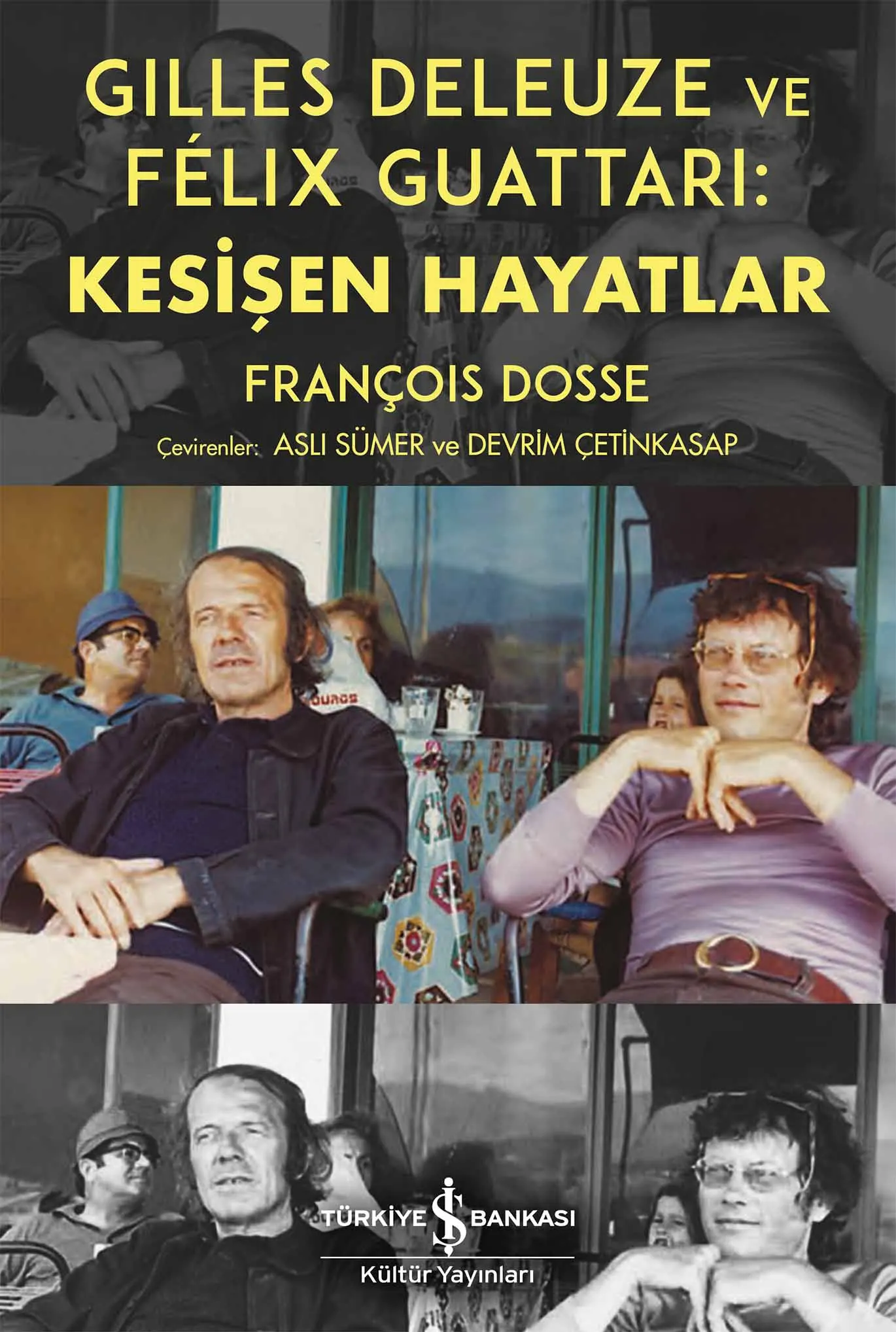
GILLES DELEUZE VE FÉLIX GUATTARI: KESİŞEN HAYATLAR (GILLES DELEUZE AND FÉLIX GUATTARI: INTERSECTING LIVES)
François Dosse
Translated from the French by: Aslı Sümer – Devrim Çetinkasap
How did Deleuze and Guattari manage to create a shared voice while preserving their individuality? What concepts did this unique partnership give birth to, and how did it transform the lives of the two thinkers? Thanks to an unexpected encounter, Gilles Deleuze’s philosophical depth and Félix Guattari’s revolutionary psychiatric practice came together and opened new horizons in the history of thought. From this meeting were born groundbreaking works such as Anti-Oedipus, A Thousand Plateaus and What Is Philosophy?.
François Dosse’s Gilles Deleuze and Félix Guattari: Intersecting Lives sheds light, in more detail than ever before, on the story behind the most striking and productive partnership in 20th-century intellectual history. Drawing on archival documents, letters and testimonies, it reveals not only an intellectual revolution but also personal hardships, emotional tensions and political struggles. Dosse meticulously examines the human stories behind this unique creative partnership. Presenting in gripping prose the human experience behind the revolutionary ideas born of the creative meeting of two minds, Intersecting Lives is an indispensable resource for anyone interested in philosophy, psychoanalysis, sociology and politics.
ERDEMLER VE BECERİLER (INTELLIGENT VIRTUE)
Julia Annas
Translated from the English by: Reha Kuldaşlı
What is virtue? Is it simply following rules or acquiring certain habits, or is it a mastery that transforms our lives? Julia Annas offers a bold answer to these questions: virtue is a skill that is learnt and developed, just like playing the piano or tennis. Bringing the depth of ancient philosophy together with modern psychology, this original approach takes virtue out of the realm of abstraction and places it at the centre of everyday life.
Offering a broad perspective that stretches from Aristotle to the Stoics and from modern research to contemporary ethical debates, the book shows how virtue is learnt and developed, and how it forms the foundation of a happy life. Based on the skill analogy, this approach reveals that virtue is not mere habit but a dynamic process requiring constant practice and reflection. While its academic depth opens new areas of debate for specialist readers, its clear prose guides anyone who wishes to explore the virtuous life. Offering innovative answers to fundamental questions such as the development of character, the unity of the virtues and their relationship to happiness, the book stands among the key works of contemporary ethical thought.
TÜRK-AMERİKAN İLİŞKİLERİNİN İLK YÜZYILINDA BAHRİYELER VE BAHRİYELİLER (1776-1876) (NAVIES AND NAVAL MEN IN THE FIRST CENTURY OF TURKISH-AMERICAN RELATIONS)
Ender Kuntsal
Turkish-American relations began in 1776 between the United States, which had declared its independence from Britain, and the provinces of Algiers, Tunis and Tripoli, known as the Garp Ocakları (the Western Garrisons). Having lost the right to trade in the Mediterranean under the British flag once its independence was recognised, the United States agreed to pay tribute to the Garp Ocakları and signed new treaties in order to regain that right.
After the Ottoman fleet was burned at Navarino during the Greek uprising, talks between Grand Admiral Hüsrev Pasha and Commodore John Rodgers resulted in the Treaty of Commerce and Navigation, signed in 1831. Through the treaty, the United States hoped to develop its trade in the Mediterranean and the Black Sea, and the Ottoman State hoped to renew its navy. Meanwhile, David Porter, formerly a commodore, was sent to Istanbul as American chargé d’affaires. Around the same time, a corvette built and brought to Istanbul by the American naval architect Henry Eckford was purchased, and Eckford began building warships on the Golden Horn. In the 1850s, naval officer Major Emin Bey – the first official state representative – and later Admiral Ateş Mehmet Salih Pasha, who would go on to become Grand Admiral, travelled to the United States to negotiate the purchase of warships. Over the course of these relations, which were also shaped by political events in Europe, many US warships visited Ottoman ports for commercial, military, scientific and diplomatic purposes, as well as to assist American citizens and missionaries.
In this book, the ships, naval officers and men of naval background who left their mark on the first century of Turkish-American relations are presented to the reader in an account that is deep and wide-ranging, yet concise enough to fit in a single volume.
Classics of Turkish Literature
METRES (THE MISTRESS)
Hüseyin Rahmi Gürpınar
Adapted into modern Turkish by: Defne Asal
In Metres (The Mistress), serialised in the newspaper İkdam in 1900 and published as a book the same year, Hüseyin Rahmi Gürpınar – one of the most singular figures in Turkish literature – uses the figure of the Europeanised spendthrift heir to satirise, with a gripping plot and humorous narration, the damage that the culture of kept mistresses, spread through misguided Westernisation, did to individuals and above all to family life, while also implicitly criticising the Servetifünun circle and its debt to literary movements such as Romanticism and Parnassianism.
Having come from Paris to Istanbul as the mistress of an elderly Greek merchant, Mademoiselle Parnas begins to roam the amorous skies of Beyoğlu after her wealthy patron dies, like a comet whose next target and next fortune no one can predict. One of those who loses his entire fortune under the spell of this femme fatale, the cause of quarrels among elegant gentlemen, is the spendthrift heir Müştak. Unable to cover the expenses of his mistress Parnas, the Parnassian Müştak asks his friend Reyhan for a loan. Reyhan gives his friend the money on condition that they share Parnas. Before long, however, jealousy and hostility break out between them. As if this were not enough, the two friends discover that they have a third partner, a pampered young dandy named Hami, and join forces to take revenge by seducing Hami’s mother Firuze Hanım and his wife Saffet Hanım with love letters. Thus, through the mocking observation and involvement of the poet and cynical philosopher Revai, Metres – in a spiral of love, marriage, betrayal, jealousy, lust, money and revenge in which comedy and tragedy are intertwined – also reveals mansion life in Istanbul, the many faces of the period’s socio-cultural landscape, its questions of education and its literary atmosphere.
Turkish Literature
SANA SESLENMEK İÇİN – SEÇME ŞİİRLER (TO CALL OUT TO YOU – SELECTED POEMS)
Ataol Behramoğlu
Sana Seslenmek İçin stands out as the most extensive selection, prepared by the poet himself, of the work of Ataol Behramoğlu, one of the leading masters of contemporary Turkish poetry, from his earliest poems to his latest. Featuring some 150 poems, the book is as much the story of the poet’s inner world as it is a powerful poetic testimony to our country and our world.
FIRTINA TANRISI’NIN ÇOCUKLARI – HİTİT DESTANI (CHILDREN OF THE STORM GOD – A HITTITE EPIC) – POETRY
Mehmet Öztürk
This epic relates in literary language the historical adventure of the Hittite State, which grew into an Anatolian empire. Through their organisational skill and the cuneiform script they used widely across Anatolia, the Hittites sustained their state for more than four hundred years, and their military and diplomatic abilities allowed them to extend it over vast territories. At times, the voice of original Hittite texts can be heard in the work. The “Hittite people” and the people of the twenty-first century in fact express a single feeling: being Anatolian… The rhythm and exuberance of the epic rest on this feeling.
“Continuing an Anatolian tradition rooted in the works of the Ionian Homer, who lived some three thousand years ago in the 8th century BC, Mehmet Öztürk turns the four-hundred-year adventure of the Hittites into an epic. Whereas Homer, in his Iliad, depicts the war between the peoples of two different lands, the Achaeans (Mycenaeans) and the Trojans, here the narrative centres on an Anatolian society, the Hittites.”
– Assoc. Prof. Dr Metin Alparslan, “From the Foreword”
Modern Classics Series
ÇOCUKLARIN GECESİ (THE CHILDREN’S NIGHT)
Maurice Maeterlinck
Translated from the French by: Deniz Resul
The Belgian writer Maurice Maeterlinck, who wrote in French and drew inspiration from French literary movements, was awarded the Nobel Prize in Literature in 1911 for his distinguished contributions to Symbolist theatre. Having emigrated to the United States when the Second World War broke out, he wrote in New York in 1941 a kind of “last testament” on the future of humanity. For this work, which he undertook in order to bring his literary output to a magnificent close, he chose a genre he had mastered: the theatre.
With its dramatic and multilayered language, Çocukların Gecesi became the philosophical tale of an extraordinary night experienced by two children. Having clashed with dark forces on that black night and managed to build a better world as dawn breaks, the children represent the people of tomorrow, the actors of the future. According to Antonin Artaud, in this work Maeterlinck pioneered “bringing many of the riches of the unconscious into literature”; while turning to themes dear to him such as materialism, nature, death and happiness, he never let go of his optimism.
Brought to light 75 years after the author’s death when his grandson found it “by a miracle”, Çocukların Gecesi is, like The Little Prince, a timeless masterpiece with a message for readers of every age.
GARİP MESLEKLER KULÜBÜ (THE CLUB OF QUEER TRADES)
Gilbert K. Chesterton
Translated from the English by: Çiçek Öztek
In The Club of Queer Trades, published in 1905, Chesterton takes the reader into the world of eccentric inventors tucked away in the remote corners of London. These inventors are not geniuses opening up scientific and technical horizons. Instead, we meet a new kind of genius who notices the invisible needs born of increasingly complex social relations and turns them into professions no one could ever have imagined. In these trades, rather than the usual commercial acumen, what shines through is the ability to apply the loftiest philosophies to the small details of human relationships – with a few hitches, of course. Chesterton, the Prince of Paradox, devotes this work to a lively workshop of humour operating in London’s gloomy atmosphere.
BALO – DÜŞMAN (THE BALL – THE ENEMY)
Irène Némirovsky
Translated from the French by: Berna Günen
In two of her earliest works, L’Ennemie (The Enemy, 1928) and Le Bal (The Ball, 1929), Irène Némirovsky turns her keen powers of observation on the unloving mother, a figure who also loomed large in her own life. Gabri, the seventeen-year-old heroine of The Enemy, and Antoinette, who has only just turned fourteen in The Ball, are young women who confront their mothers’ callous indifference in different ways. The revenge Gabri plots – callously in her turn – and the revenge Antoinette plots with quiet wisdom stand out as early proof of Némirovsky’s ability to explore human psychology in depth.
Of the two works, which the author published under the pseudonym Pierre Nerey, The Ball kept the attention it won in the 1930s in the years that followed; it entered school curricula in the 1980s and was adapted as an opera in 2010 and for the stage in 2013.
MASUM AZİZLER (THE HOLY INNOCENTS)
Miguel Delibes
Translated from the Spanish by: Saliha Seniz Coşkun – Esra Kılıç
One of the leading writers of post-Civil War Spanish literature, Delibes is known for his empathy for the poor as well as his devotion to rural Spain and its traditions. His works focus on the lives of labourers, shepherds, blacksmiths and hunters, and his complex characters reflect the cultural and political struggles that followed the Spanish Civil War.
In The Holy Innocents (1981), regarded as one of his most important works, he draws attention, through the story of a provincial family working on an estate in Extremadura in the early 1960s, to the consequences of a brutal social hierarchy that strips people of their humanity. Azarías, the family member with an intellectual disability who lives in close communion with nature and treats every living creature around him with tenderness, emerges as a “holy innocent”. Home to those who give orders and those who obey – masters and the servants who, in their wretched existence, submit to them in every circumstance – the estate is almost a “microcosm” ruled by social inequality.
The Holy Innocents has been translated into many languages, and the film adaptation by Spanish director Mario Camus was honoured at the 1984 Cannes Film Festival.
Business
USTALAŞMANIN 12 KURALI (GET BETTER AT ANYTHING: 12 MAXIMS FOR MASTERY)
Scott H. Young
Translated from the English by: Sevgi Halime Özçelik
Life depends on learning. We all spend decades in school getting an education. We want to succeed at work – not only for the advantages of being among the best at what we do, but also for the pride of practising a craft with mastery. Even in the things we do for fun, we take great pleasure in feeling that we can get better.
Yet for all this, learning remains a mystery. Sometimes it happens effortlessly – as when we find our way around an unfamiliar neighbourhood with ease, or get the hang of the routine at a new workplace. At other times it is very hard. We spend hours hunched over a desk and still fail the exam. We want to change companies, sectors, perhaps even professions, but a voice inside tells us we are not capable of taking that step. Years of driving, cooking or playing tennis do not always add up to mastery. Improvement, even when we achieve it, does not last.
Author Scott H. Young investigates why acquiring new skills is so hard for people. He argues that progress depends on learning from others, from practice and from experience, and sums up what we need to do to improve the way we learn in 12 core rules of learning. Whether you are preparing for an exam, learning a new skill at work or trying to do better in any field that interests you, these rules will help you do it better.